
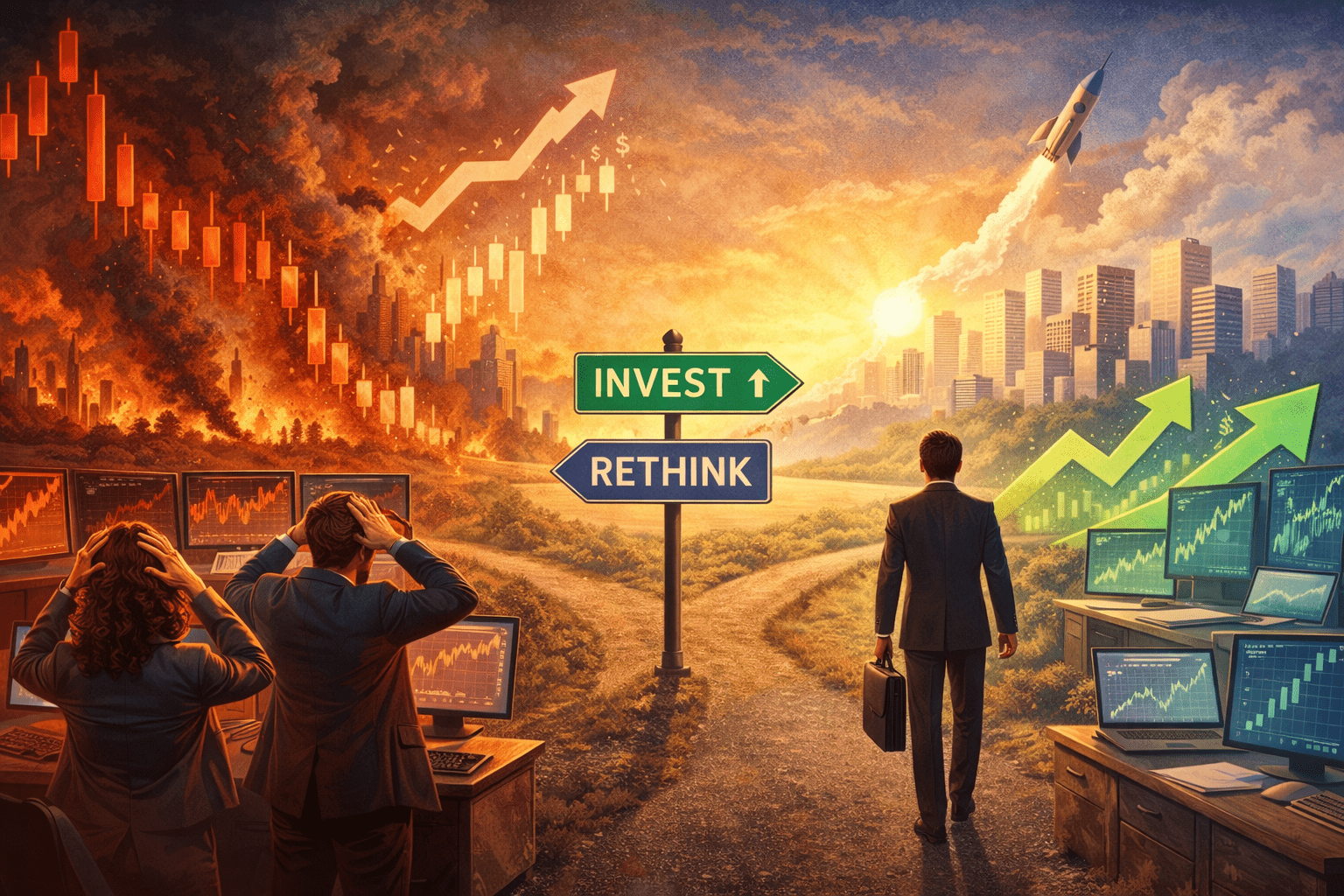
The anxiety doesn’t show up as panic
Most people aren’t terrified of a market crash.
They’re uneasy.
They keep an eye on headlines.
They hesitate before making big decisions.
They feel exposed without being sure to what.
It’s not the sharp fear of losing everything.
It’s the dull pressure of knowing that one wrong move could remove options they don’t yet fully have.
That distinction matters.
The common story focuses on crashes
Market fear is usually explained through events.
- Recessions.
- Corrections.
- Bubbles bursting.
These explanations dominate because they’re dramatic and measurable. They give fear a clear shape.
But most people aren’t reacting to an imminent collapse.
They’re reacting to fragility.
They sense that their financial position has less margin than it used to — and that recovery from mistakes would be harder now than in the past.
That fear doesn’t come from volatility.
It comes from constraint.
Optionality is what actually disappears first
Optionality is the ability to wait, pivot, or say no.
It’s time.
It’s liquidity.
It’s flexibility under pressure.
Markets don’t need to crash to destroy optionality.
Rising costs, tighter credit, and slower asset growth quietly do the job. Each removes a small degree of freedom. Over time, those losses compound.
People still have income.
They still have jobs.
They just have fewer moves available.
That’s what feels dangerous.
Why volatility feels more threatening now
Volatility itself isn’t new.
What’s new is how many people are operating without buffers.
High fixed costs, long-term debt, and dependence on steady income mean that even small disruptions carry outsized consequences. A temporary downturn can trigger permanent setbacks.
So people don’t fear downturns because they’re dramatic.
They fear them because they’re asymmetrical.
Downside hurts more than upside helps.
The difference between risk and ruin
This is where most advice falls short.
Risk is exposure to uncertainty.
Ruin is the loss of recovery.
High performers are rarely risk-averse.
They’re ruin-averse.
They understand that:
-
You can survive volatility with optionality
-
You can’t survive constraint with confidence
Markets reward those who can wait.
They punish those who must act.
Why “playing it safe” often backfires
In uncertain environments, people often respond by freezing.
They hold cash indefinitely.
They delay decisions.
They avoid exposure entirely.
This feels cautious.
It often increases risk.
Without optionality, caution becomes fragility. Cash loses value. Opportunities pass. The cost of waiting quietly accumulates.
Safety without structure is just delayed pressure.
What capable people tend to notice earlier
Those who navigate uncertainty well don’t try to predict markets.
They focus on preserving maneuverability.
They think less about returns and more about:
-
how quickly they can respond
-
how many paths remain open
-
how exposed they are to forced decisions
They don’t eliminate risk.
They position themselves so risk isn’t fatal.
Why this connects to currency and feeling “behind”
This is where the threads come together.
Currency erosion reduces the usefulness of cash.
Asset inflation rewards early exposure.
Rising fixed costs shrink flexibility.
So people feel:
-
behind financially
-
anxious about markets
-
unsure where safety actually lives
Not because they’re uninformed — but because the traditional signals no longer align.
The system rewards optionality.
Most people are taught to ignore it.
A better way to interpret market fear
Market fear isn’t a warning about collapse.
It’s feedback about position.
When fear rises, it’s often because:
-
flexibility is low
-
commitments are high
-
recovery feels uncertain
The question isn’t “Will markets crash?”
It’s:
“How many moves do I have if conditions change?”
That question doesn’t eliminate uncertainty.
It restores agency.
And in volatile systems, agency is the most valuable asset of all.






0 Comments