
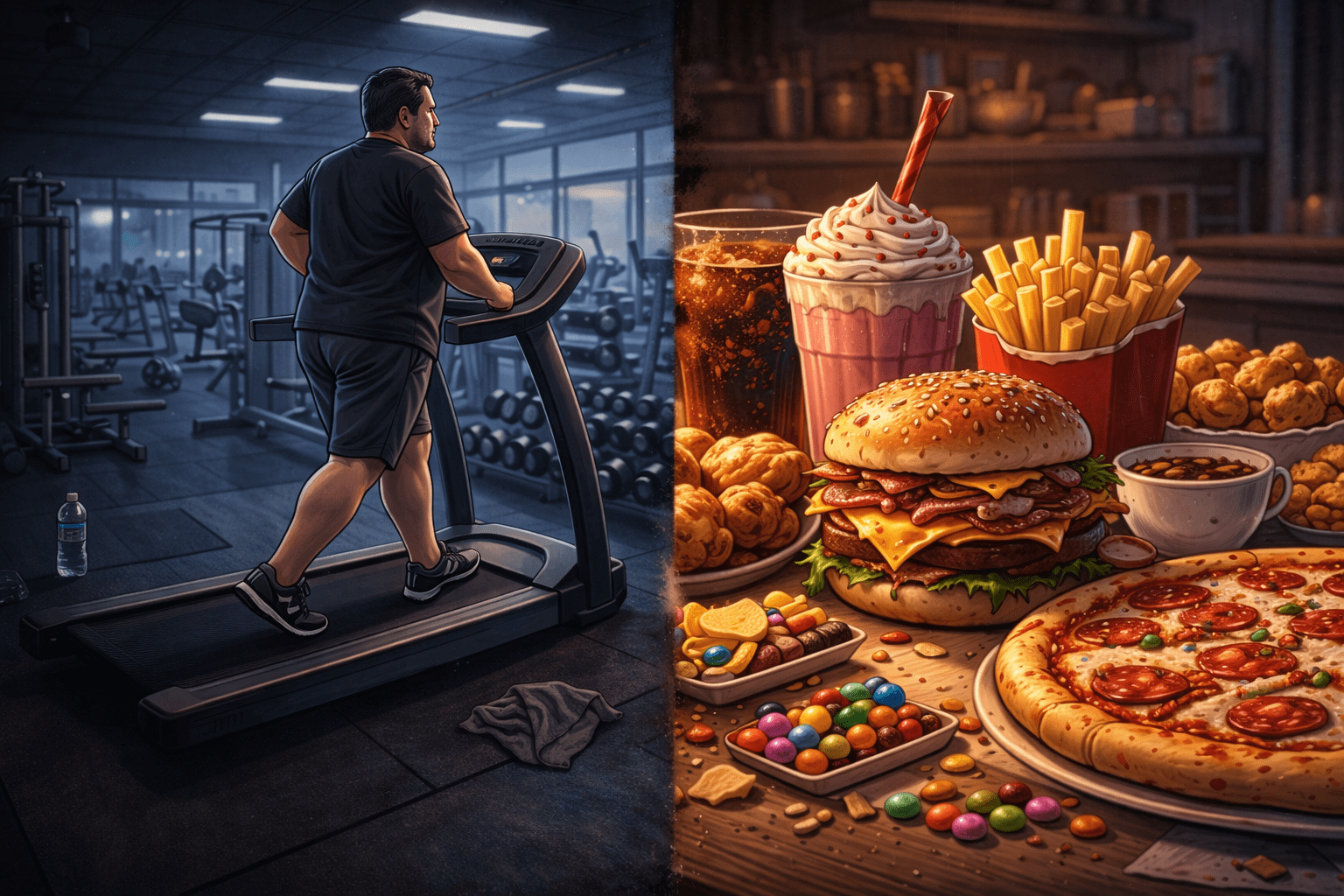
The belief feels reasonable
Many people operate under a simple assumption:
If you train hard enough, you can eat more freely.
The logic feels sound.
Exercise burns calories.
Movement signals health.
Effort should offset indulgence.
So people lift, run, sweat — and expect balance to follow.
When it doesn’t, confusion sets in.
The usual explanation blames consistency
When results don’t match effort, the explanation is usually behavioral.
You’re not training hard enough.
You’re not consistent enough.
You’re underestimating intake.
Sometimes that’s true.
But it doesn’t explain why people can increase training volume, maintain discipline, and still feel inflamed, sluggish, or metabolically stuck.
The problem isn’t effort.
It’s expectation.
Exercise improves capacity — not inputs
Exercise is incredibly powerful.
It builds strength.
Improves insulin sensitivity.
Supports mental health.
But it doesn’t fundamentally change what food does in the body.
Ultra-processed inputs still spike insulin.
Poor fats still drive inflammation.
Excess sugar still disrupts hunger signaling.
Training expands tolerance.
It doesn’t erase exposure.
That’s the distinction most people miss.
Why some people seem to “get away with it”
This is where confusion deepens.
Some people train hard and eat poorly without obvious consequences — at least for a while.
What’s usually happening:
-
higher baseline muscle mass
-
more total movement outside the gym
-
better sleep or stress profiles
-
earlier entry into healthy habits
These buffers absorb damage temporarily.
But buffers aren’t immunity.
They’re delay.
The compounding mismatch
The real issue isn’t one bad meal.
It’s repetition.
If food consistently overwhelms recovery, exercise becomes damage control instead of adaptation. Training adds stress on top of an already overloaded system.
The body responds by holding water, resisting fat loss, and dulling energy — even as fitness improves.
People feel stronger but worse.
That mismatch leads many to push harder, which compounds the problem.
What capable people tend to see earlier
People who stay lean, energetic, and resilient don’t use exercise as forgiveness.
They use it as amplification.
They understand:
-
training reveals diet quality
-
recovery determines adaptation
-
food sets the ceiling, not the gym
Exercise becomes more effective when inputs are clean and predictable — not because of purity, but because signals are clearer.
Why this mirrors other modern systems
The pattern is familiar.
Just as high income can’t fix bad financial structure, high activity can’t fix degraded inputs.
Effort amplifies systems.
It doesn’t replace them.
A clearer way to see exercise
The gym isn’t a reset button.
It’s a stressor that requires cooperation from everything else.
The real question isn’t “How hard did I train?”
It’s:
“What environment am I asking my body to adapt to?”
When that environment is supportive, exercise compounds benefits.
When it isn’t, exercise exposes the limits faster.
That clarity doesn’t reduce effort.
It directs it.






0 Comments