
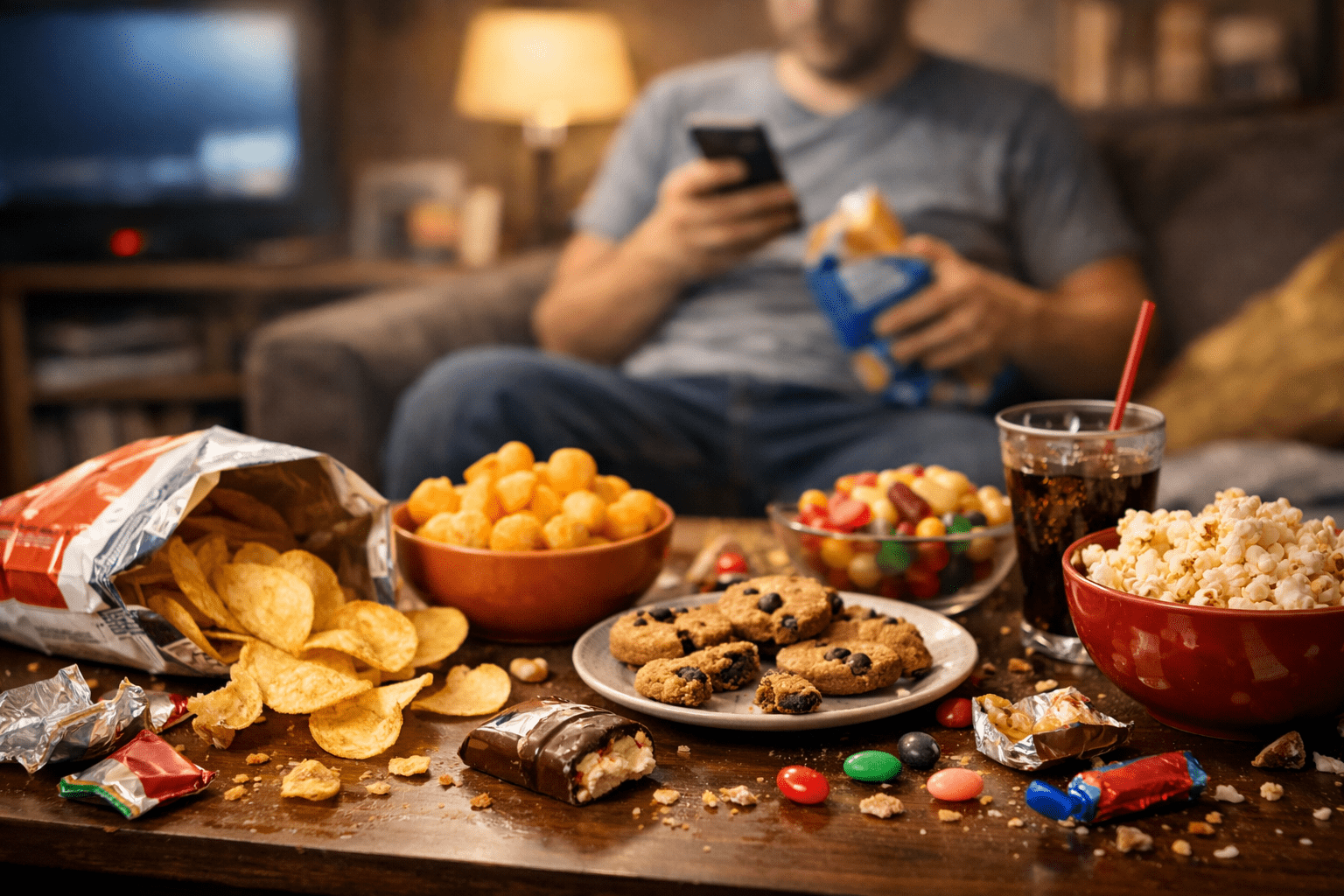
The habit feels harmless
Snacking rarely feels like a problem.
It’s small.
It’s frequent.
It’s often framed as “listening to your body.”
A handful of something between meals. A bar during work. A bite here, a sip there.
No excess. No indulgence. Just constant intake.
And yet, many people who snack regularly report the same pattern: unstable energy, muted hunger cues, persistent cravings, and difficulty feeling truly satisfied after meals.
The issue isn’t what they’re eating.
It’s how often.
The common explanation focuses on calories
When snacking is questioned, the response is usually numerical.
It’s fine if calories are controlled.
It’s fine if portions are small.
It’s fine if the food is “healthy.”
Those explanations assume the body only responds to quantity.
It doesn’t.
The body responds to signals — and frequency is one of the strongest.
Eating is a metabolic event, not a neutral act
Every time you eat, the body shifts state.
Insulin rises.
Digestion activates.
The nervous system adjusts.
In isolation, this is normal.
Repeated without pause, it becomes taxing.
Constant snacking keeps the body in perpetual processing mode. There’s no clear beginning or end — just ongoing activity.
The system never fully settles.
Why hunger cues dull over time
Hunger isn’t just about need.
It’s about rhythm.
When eating windows blur, the body loses contrast. Signals flatten. Appetite becomes ambiguous — less “hungry” and more “unsatisfied.”
People eat not because hunger rises sharply, but because it never fully disappears.
This creates a loop:
-
low-level hunger
-
small intake
-
brief relief
-
rapid return
The result isn’t overeating.
It’s never fully eating — or fully resting.
The energy paradox
Many people snack to maintain energy.
The opposite often happens.
Frequent intake produces short spikes followed by subtle dips. Over time, this creates the sensation of needing food to function — even when caloric intake is sufficient.
Energy becomes reactive instead of stable.
The body learns to expect constant input and struggles when it doesn’t arrive.
Why snacking feels necessary in modern life
Snacking didn’t emerge randomly.
Modern schedules compress meals.
Workdays fragment attention.
Stress blunts appetite, then rebounds it.
Snacking fills gaps created by an environment that no longer supports clear eating boundaries.
It feels adaptive.
But adaptation isn’t always improvement.
What capable people tend to notice earlier
People with stable energy rarely snack out of habit.
They consolidate intake.
They eat fewer times — but more deliberately. They allow hunger to build, then fully resolve it.
Not because hunger is virtuous — but because contrast restores signal clarity.
Eating becomes an event again, not background noise.
Why this mirrors other modern patterns
This is the same pattern seen elsewhere.
Constant notifications degrade focus.
Constant spending erodes savings.
Constant stimulation dulls response.
Uninterrupted input weakens systems that evolved for cycles.
The problem isn’t excess.
It’s continuity without rest.
A clearer way to see snacking
Snacking isn’t inherently bad.
But constant snacking removes the pauses that make eating effective.
The real question isn’t “What am I snacking on?”
It’s:
“How often does my body get to fully finish a cycle?”
Where cycles close, systems recover.
Where they don’t, subtle dysfunction accumulates — quietly, predictably, and without drama.






0 Comments