
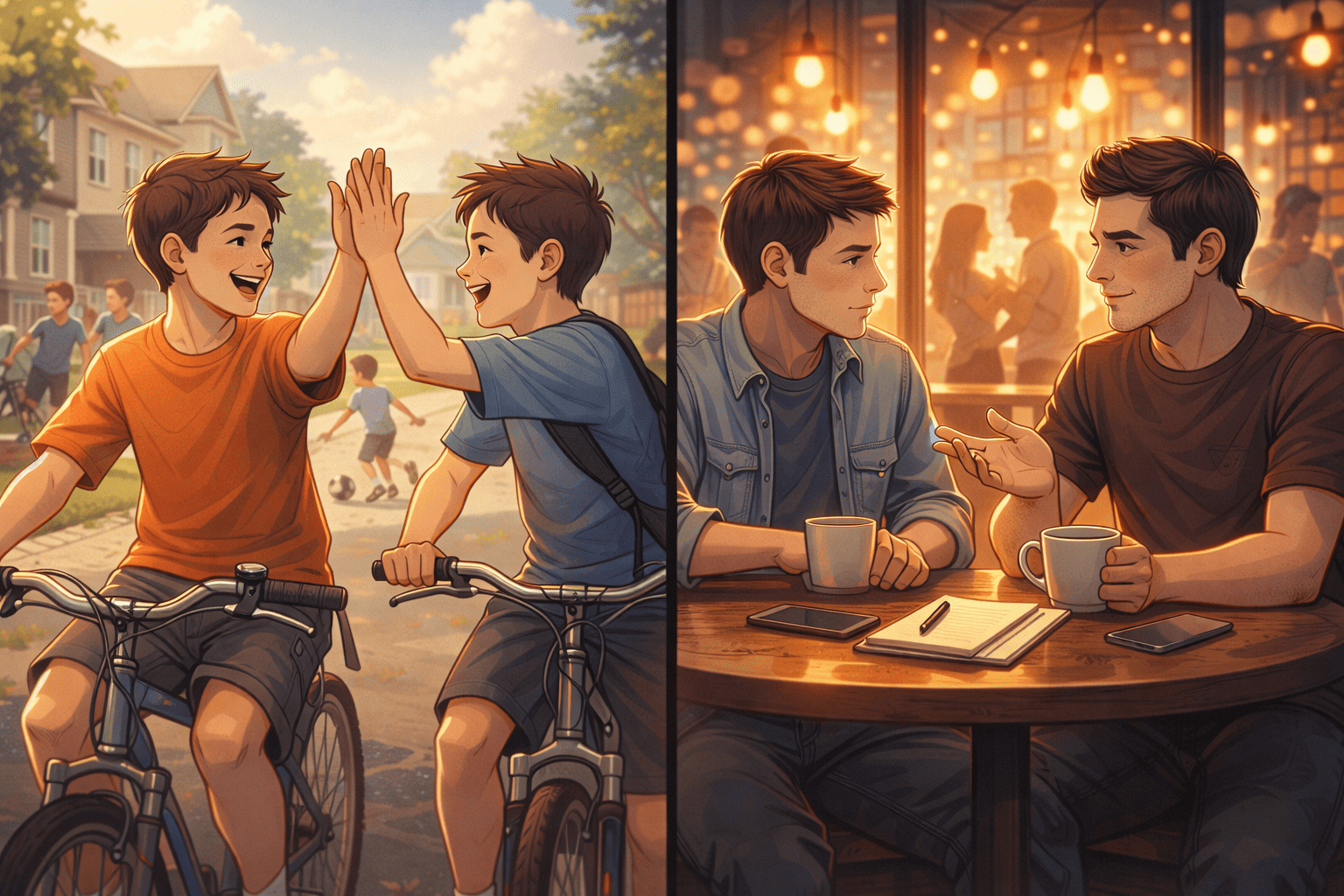
The loss isn’t dramatic
Most people don’t remember losing friends.
They just notice that they stopped forming.
Life fills up.
Schedules tighten.
Weeks pass without contact.
Nothing breaks. Nothing ends. The relationships simply thin out — until one day, there’s no longer anyone you speak to regularly outside of obligation.
The change feels passive.
It isn’t.
The common explanation blames busyness
Friendship erosion is usually explained by time scarcity.
Careers get demanding.
Families take priority.
Life gets complicated.
All of that is true.
But it doesn’t explain why people in equally busy eras maintained deep, durable friendships — or why modern friendships dissolve even when time technically exists.
The issue isn’t busyness alone.
It’s structure.
Friendship used to be built into daily life
Historically, friendship didn’t require planning.
People shared:
-
workplaces
-
neighborhoods
-
routines
-
institutions
Seeing the same people repeatedly wasn’t intentional — it was unavoidable.
That repetition created familiarity. Familiarity created trust. Trust created friendship.
Modern life removed those defaults.
Work is remote or transient.
Communities are fluid.
Schedules are individualized.
Friendship no longer forms through proximity.
It must be chosen.
Why optionality weakens bonds
When friendship becomes optional, it competes with everything else.
If attendance isn’t expected, absence carries no cost. If contact isn’t regular, drift feels natural.
But friendship doesn’t strengthen through intensity.
It strengthens through continuity.
Without shared structure, relationships rely on motivation — and motivation fluctuates.
So connections fade not because they lack value, but because they lack scaffolding.
The quiet effect on identity and stability
Friendship isn’t just social.
It’s orienting.
Friends:
-
mirror behavior
-
calibrate perspective
-
absorb pressure
Without them, people become more self-contained. Decisions feel heavier. Identity narrows.
This isn’t loneliness.
It’s isolation through autonomy.
Why adults struggle to rebuild what faded naturally
As adults, people often try to recreate friendship through effort.
They reach out sporadically.
They schedule occasional meetups.
They rely on shared interests.
But without repetition and obligation, these attempts struggle to deepen.
It’s not that people forgot how to connect.
It’s that the environment no longer does the work for them.
What capable people tend to see earlier
People who maintain strong friendships don’t rely on chemistry.
They build containers.
They commit to:
-
standing plans
-
shared responsibilities
-
recurring presence
They remove decision-making from connection.
Friendship survives because it’s expected — not because it’s convenient.
Why this mirrors everything else in modern life
This pattern appears everywhere.
Health requires structure.
Financial stability requires structure.
Influence requires structure.
Friendship is no different.
When systems disappear, outcomes don’t vanish immediately.
They decay.
A clearer way to think about friendship
Friendship didn’t become harder because people became colder.
It became harder because it stopped being automatic.
The real question isn’t “Why don’t I have closer friendships?”
It’s:
“What in my life makes connection inevitable?”
Where inevitability exists, friendship follows.
Where everything is optional, nothing endures without intention.





0 Comments