
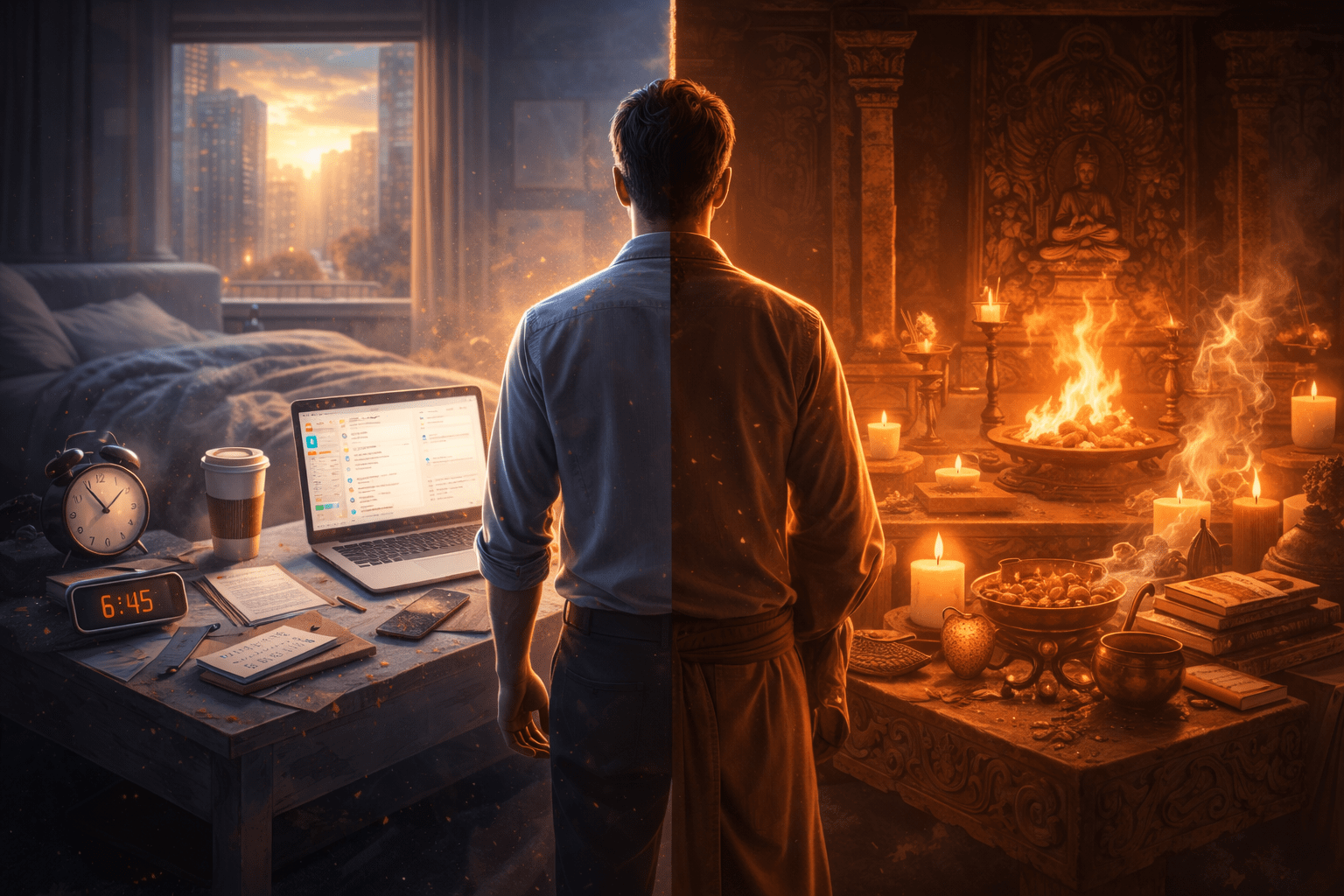
Life feels organized, but oddly flat
Many people run disciplined lives.
They wake at the same time.
They follow set routines.
They move efficiently from one obligation to the next.
And yet, something feels missing.
Days blur together. Milestones feel anticlimactic. Even meaningful events lose weight quickly. Life feels managed — but not anchored.
This isn’t burnout.
It’s a loss of contrast.
The common explanation blames meaning or motivation
When life feels hollow, the diagnosis is often internal.
People need more purpose.
They need gratitude.
They need better mindset.
Those explanations assume meaning is something people generate internally.
Historically, it wasn’t.
Meaning emerged from structure.
Ritual used to frame experience
Ritual wasn’t about belief.
It was about transition.
Meals marked time.
Gatherings marked belonging.
Beginnings and endings were clearly defined.
Rituals created psychological closure. They told the nervous system, this moment is different from the last one.
Routine didn’t replace ritual because it was better.
It replaced it because it was efficient.
Why efficiency flattens experience
Routine optimizes for repeatability.
It removes ambiguity.
It reduces decision-making.
It keeps systems running smoothly.
But routine doesn’t create meaning.
It treats all moments as interchangeable — which is useful for productivity, but corrosive for memory and emotional weight.
Without ritual, life becomes continuous process.
Nothing fully starts.
Nothing fully ends.
The hidden cost of uninterrupted flow
When moments lack boundaries, the mind struggles to register significance.
Celebrations feel brief.
Rest feels incomplete.
Transitions feel rushed.
This creates a strange fatigue — not from effort, but from sameness.
People don’t feel overwhelmed.
They feel unmarked.
Why modern life accelerated this shift
Ritual requires:
-
shared time
-
physical presence
-
repetition without efficiency
Modern systems resist all three.
Schedules fragment.
Attention disperses.
Events compress.
Routine thrives in this environment.
Ritual doesn’t.
So people optimize their days — and lose the pauses that once gave those days texture.
What capable people tend to notice earlier
People who feel grounded don’t necessarily do more.
They mark moments.
They:
-
create beginnings and endings
-
protect transitions
-
repeat certain acts with intention
These aren’t habits for output.
They’re signals to the mind that something matters.
Ritual restores orientation.
Why this mirrors other modern losses
This pattern echoes across domains.
Health suffers when cycles don’t close.
Relationships weaken when transitions aren’t acknowledged.
Work exhausts when effort never resolves.
Routine sustains systems.
Ritual sustains people.
A clearer way to think about ritual
Ritual isn’t nostalgia.
It’s infrastructure for meaning.
The question isn’t “How do I add purpose to my life?”
It’s:
“What moments in my life are clearly marked as significant?”
Where nothing is marked, everything blends.
And when everything blends, progress becomes harder to feel — even when it’s happening.






0 Comments